- Home
- Rustic Garden Projects
- How to Build a Twig Fence
Jacki Cammidge is a Certified Horticulturist and rustic garden artisan with 30+ years creating twig trellises, archways, and hypertufa pieces from natural materials.
How to Build a Twig Fence
Using Branches, Wire, and Willow
Building a twig fence for bordering your vegetable garden, around a flower bed, or to give privacy from neighbors is a satisfying and challenging project.
used can be simple - wiring twigs to the top of an existing fence of wire or wood, or more complex - building separate panels and attaching them to posts pounded into the ground.
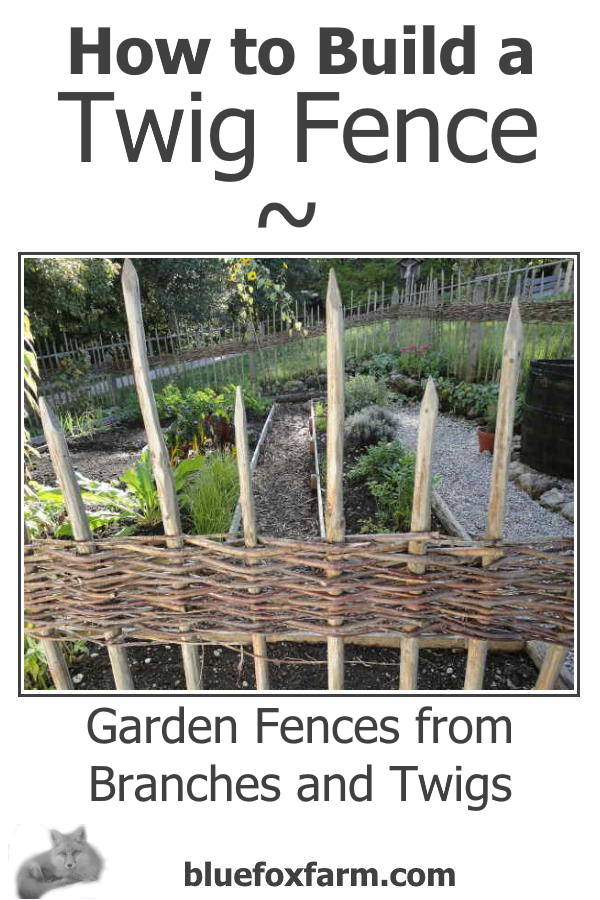
Building your Rustic Twig Fence
Using a wire strung between two solid objects (a house and an archway for instance) you can wire upright twigs in a palisade style.
The twigs can be woven between upright poles to form a hurdle type fence panel.
The poles can be inserted into pipes pounded into the ground - this is a great technique if you have rocky soil, or an area where you can't get a machine in to pound posts.
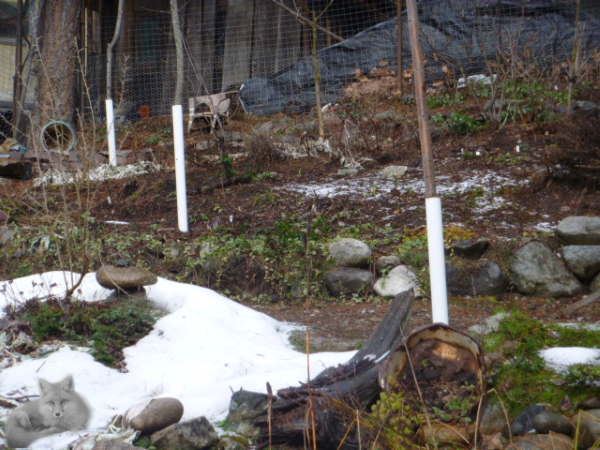 Post holders - pipes pounded into the ground to hold upright twigs...
Make sure you have an odd number of uprights to weave.
Slender canes of willow or grapevines will work best for this technique.
Soaking the canes or vines in water for a few hours or overnight will make them more pliable.
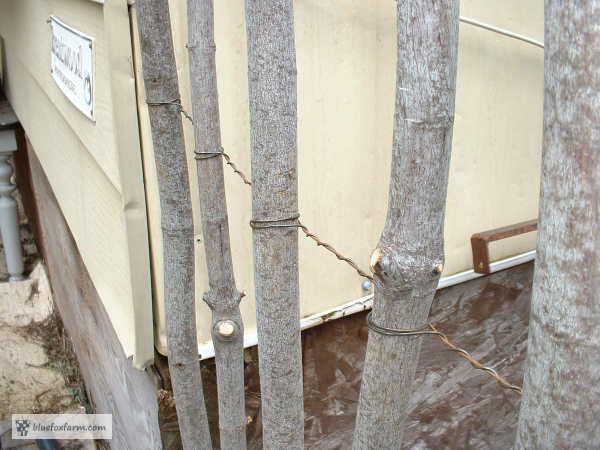
Wire the twigs to a frame and then attach the frame by wire or nails to posts.
If you wire it on, then you can adjust the placement of the fence or individual panels as needed.
This option is great for a fence
that is for temporary use. See more about wire techniques for crafts here.
Nailing or screwing the panels can give more strength to the fence especially if it will be in a windy area, or to keep dogs in.

String a wire between two posts or trees and attach the twigs in a lattice pattern diagonally.
This provides a decorative effect. Use sturdy wire for the main fence; recycled phone or electrical cable works well, and then tie wire used for concrete work for the attachment wire.
Handy Technique for Recycling Wire
Unwind used telephone cable or other multi ply wire with your
cordless drill by putting the end carefully in the chuck, then slowly trigger
the drill to unwind it.
Make sure you have enough room to stretch the wire out so it doesn't kink.
This page has a video about winding wire together - the same technique in reverse will unwind it.
For a more formidable pattern for keeping chickens or dogs inside and for privacy, use the vertical palisade style.
Closely spaced vertical twigs will allow light and air movement while spacing the verticals further apart will make the best snow fencing, allowing the wind to go through it, not create a sail.
Willow twigs, freshly cut, can be bent to make a fence like this one;
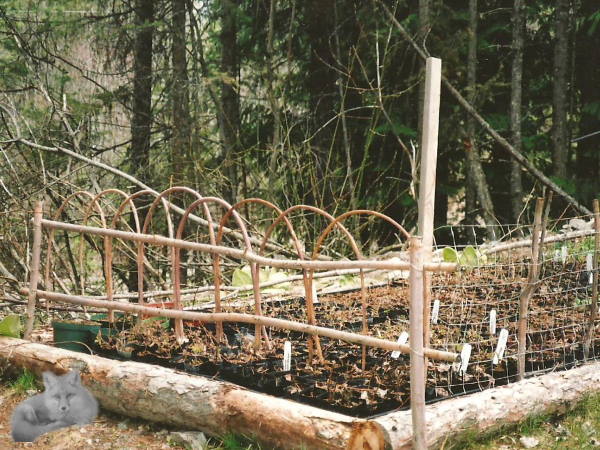 How to build a bent twig fence using willow twigs...
The twigs can disguise other fence systems, like page wire (used for keeping animals confined) or made out of rebar or other metal structures.
Chain link fences are used a lot, but they're so ugly. Tie or wire twigs and branches to cover them and disguise the industrial look of them.
In lieu of chain link, we built a fence out of rope and twigs, both for economy, and to re-use the old rope we acquired.
Panels or hurdles have long been used to confine small animals, like sheep.
The panels are all made a consistent size, then joined together with wire or string to make an enclosure. If one gets damaged, it's easy to remove it and replace it with another.
In Britain, a thriving hazel copse was always an important part of the homestead; multipurpose farming - good for the nut crop and as material for fencing. Willows are sometimes cultivated for the same purpose.
Ornamental vines or shrubs planted close to the fence will add more strength and look very romantic and beautiful as they grow up the support of the twig fence.
If you have access to a lot of scrubby twigs, or long vines, a dead hedge might be as good option.
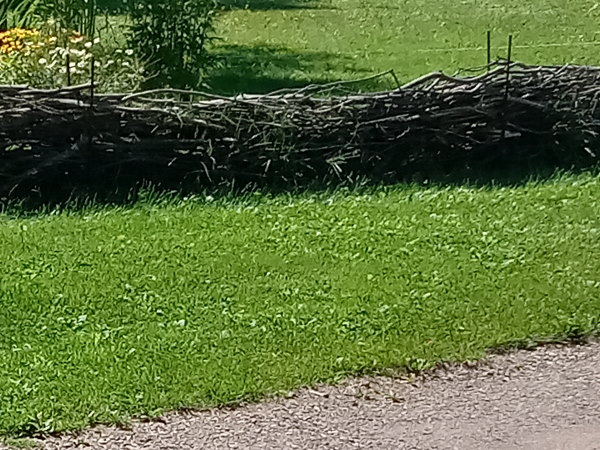 A Dead Hedge in a graceful swoop toward the driveway
In time, a living fence or 'fedge' can become thick enough to keep in (or out) fairly unruly animals, especially if there are thorn bearing bushes and trees, like hawthorn, roses and gorse.
As an added benefit, these long term fences attract birds and pollinators to help with garden chores.
The upkeep on a fedge is a bit more than in some options, as each year the twigs need to be cut almost in half and bent over, woven through each other to become thicker each season.
Making a twig fence adds dimension to your garden, as well as keeping out pests.
You can also use your twig fence to hang a succulent mosaic, found objects or painted barnboard signs or other garden art.
What is the best way to attach twigs when building a fence?
What is the best way to attach twigs when building a fence?
On some projects, it's best to use nails or screws, but for fences, because they will move and need more flexibility, it's better to wire the pieces together.
Can you use a preservative for twigs to keep the fence longer?
Can you use a preservative for twigs to keep the fence longer?
All twig projects are considered 'ephemeral' and not meant to be long lasting, especially if exposed to the weather outdoors. A light coating of oil will protect them for a while, if redone every year.
You might like these
Root Baskets; roots are a great natural material too
Making Root Baskets using the same techniques as for twig baskets gives a whole new meaning to rustic crafts; textural and twisted, roots are a great natural material
Fruit Wood Tool Handles; the apple doesn't fall far from the tree
Fruit Wood Tool Handles; a gift from my forebears, and a link to my past; rustic crafts, wood carving and carpentry are melded together into a unique and interesting creative life
Bark Bows - decorate your rustic crafts with a primitive bow
Make Bark Bows to decorate rustic twig wreaths in the primitive country style...


 Jacki Cammidge
AUTHOR BIO
Jacki Cammidge is a Certified Horticulturist with a diploma in Ornamental Horticulture and the rustic garden artisan behind Woman of Many Sticks. Over 30+ years, she built custom twig trellises, archways, clematis gazebos, and 100+ hypertufa pieces using natural materials and upcycled finds. See her work on Facebook and Pinterest. Now retired, she still loves growing and harvesting willow.
If you're curious how broken pots, twigs and wire combine into magic, let's explore creativity in action.
Fill in the form below for your copy;
(Don't be disappointed - use an email address that will accept the free download - some .aol email addresses won't.
If you don't see your download within a few minutes, try again with another email address - sorry for the bother.)




Popular Posts You Can't Miss




Woman of Many Sticks - find out why I'm called that...
Join my e-mail group;
Sign up for the Rurality Newsletter here: (click on the bucket!)
Blue Fox Farm Home | About Me | Contact Me | Site Map | Privacy Policy | Copyright
Copyright © 2002- BlueFoxFarm.com All rights reserved


We acknowledge the traditional owners and custodians of the lands on which we live and work and pay our respects to elders past, present and future. Our business is created on the Mi’kmaq lands we call Epekwitk.