- Home
- Hypertufa Projects
- How to Make Twig Handled Hypertufa Baskets
Jacki Cammidge is a Certified Horticulturist and rustic garden artisan with 30+ years creating twig trellises, archways, and hypertufa pieces from natural materials.
How to Make Twig Handled Hypertufa Baskets
Embedded Handles in Hypertufa Planters
Jacki Cammidge, The Woman of Many Sticks, is a participant in the Amazon Services LLC Associates Program, an affiliate advertising program designed to provide a means for sites to earn advertising fees by advertising and linking to amazon.com. The cost to you, if you purchase something through my link, is the same.
Got baskets salvaged from thrift stores? Looking for ways to use them in your garden crafts? Well, here's a way to utilize them for something really unique.
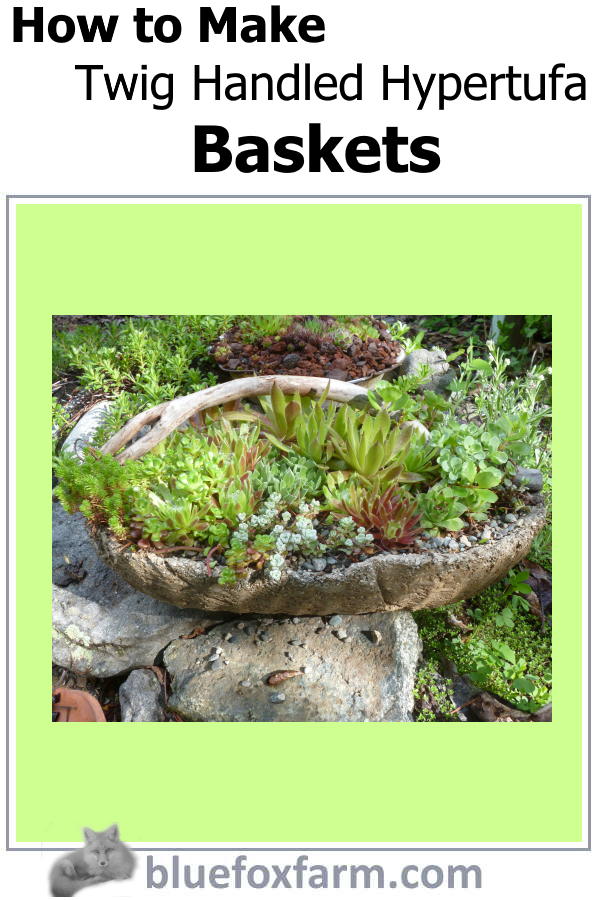
I had a whole lot of baskets of all sizes and shapes, and I knew that one day, I would find a use for them.
Inspiration struck when I saw the potential for using the baskets for hypertufa molds, and then adding a wiggly twig for even more charm and character.
Combining two of my favorite materials (twigs and hypertufa) to create some very interesting planters and containers for some beautiful alpines or hardy succulents is a match made in heaven.
This short tutorial shows how I made some of these creations:
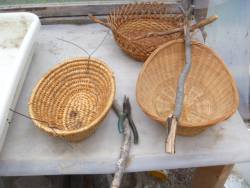 Baskets are everywhere, for free
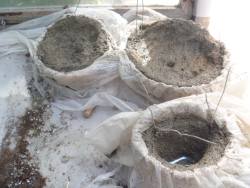 Deciding which twig goes with which basket...
...much more difficult...
The baskets were chosen for this project based on the size and the pattern of the weaving; using thin poly film to line them with before pressing the hypertufa mix into them will allow the pattern to show - the thinner the poly, the better the pattern of the woven twigs will show through.
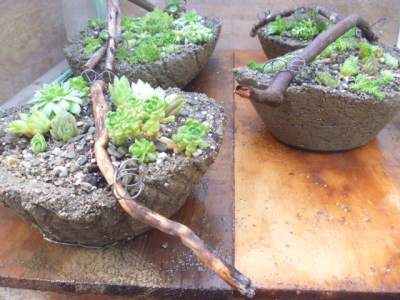 The finished Twig Handled Hypertufa Baskets - planted with many different Sedum and Sempervivum
Two pieces of wire are laid into the hypertufa mix - put in a thin layer, then the wire, then another layer of the mix. The depth differs depending on the size of the basket (and subsequent planter).
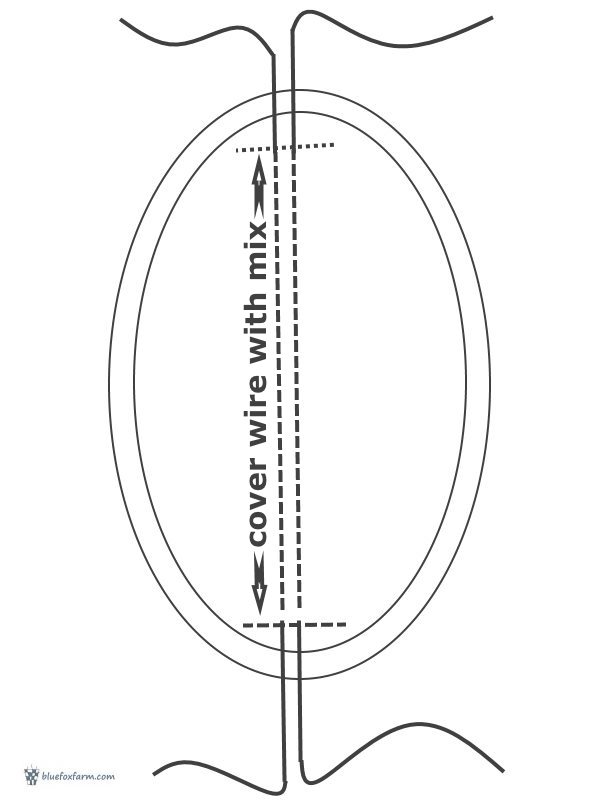
These are where you'll attach the two ends of the twig. The mix has to be dry before you attach the twig - don't get into a hurry at this point.
Make sure the hypertufa is thick enough - too thin, and the wire will damage and simply pull through the hypertufa if someone picks it up by the handle.
Age matters; the longer you cure the basket, the stronger it will be.
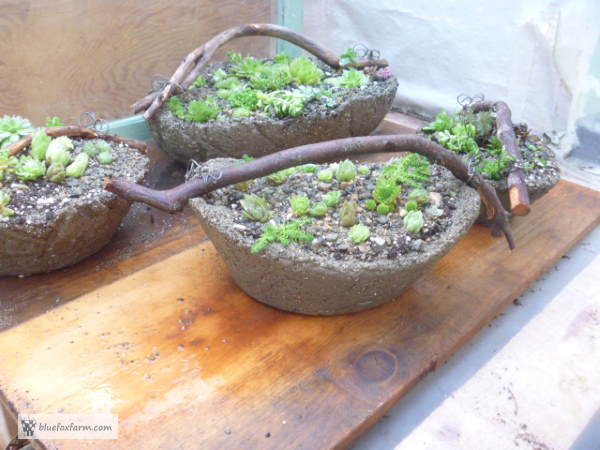 The finished Twig Handled Hypertufa Baskets in August 2012
This basket I've made continues to look amazing, even after several years.
The picture at the bottom of the page was taken in May 2013 while the picture below was from September 2012.
Many of the plants did well, although some had to be replaced over time.
There is no special care taken for winter - the baskets are placed on the ground, and snow is allowed to cover them for protection.
It's always interesting to watch them emerge from the snow as it melts, to see what's survived. And, to see how the twig ages. Amelanchier or maple are the best twig choices here.
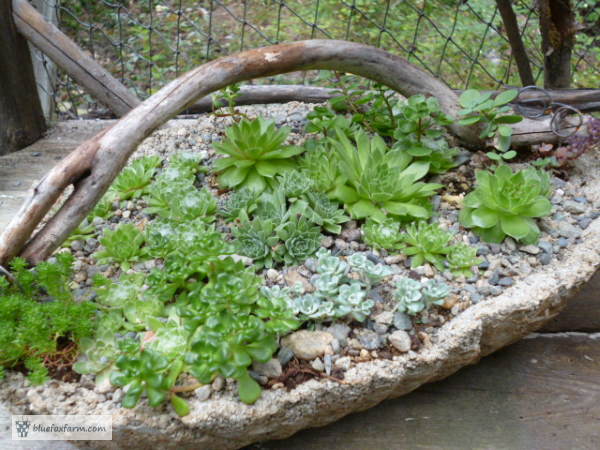 Hypertufa Twig Handled Basket in September 2012
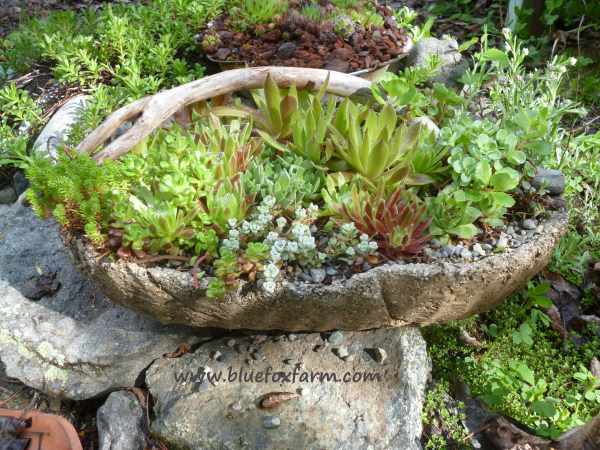 The lovely result of combining hypertufa, twigs and hardy succulents...May 2013
Finding uses for thrift store finds and rustic salvage always gives me a thrill - and this project was no different.
I like combining two completely different materials (or three in this case - the basket for the mold, the hypertufa, and the wiggly twig) to make something really unique and different for succulent plant displays.
As an avid collector of hardy Sedum and Sempervivum, I'm always looking for something to plant with them.
Don't forget to share your rustic craft with me! I love seeing how people take an idea and make it totally their own.
You might need these supplies;
These links open in a new tab for your convenience;
Vinyl gloves to protect your hands.
Eyewash, just in case of a splash.
Rubber bands, to create texture on your plastic molds.
Bubble wrap, for a crinkly texture.
Honeycomb Packing - an alternative to bubble wrap, but even better.
Pam Cooking Spray, as a form release for the mold.
Plastic film to line the mold.
Please note; due to the fragile nature of even well cured hypertufa, this project should be picked up carefully - not by the twig.
Questions and Answers;
What’s the best wire to embed as handles in hypertufa planters to prevent rust and pull-out?
What’s the best wire to embed as handles in hypertufa planters to prevent rust and pull-out?
For the project seen here, I used my favorite tie wire, which is commonly used for tying rebar as a structural strengthener for concrete. I figured that it would work as well for this purpose, although it does tend to rust.
I like the look of it, when it goes a dark rusty colour, and like all hypertufa projects, it will last as long as the pot itself.
If you wanted it to be longer lasting, say, for instance, under cover, I might use stainless steel wire. The trade off is that it's more obvious, and doesn't blend in as well as tie wire.
Galvanized is yet another option, which might work well to do the wiring, as in, flexible. It also has a great dull grey colour as it ages. However, I haven't yet found the right gauge of galvanized wire to use for this kind of project - still working on it.
How do I use bucket wire handles as embedded handles in a hypertufa planter mold?
How do I use bucket wire handles as embedded handles in a hypertufa planter mold?
This is a quick way to get handles, plus they are all similar in size so you could get a fairly consistent result if you were making several baskets and wanted them the same.
The drawbacks I can see with this is that there's not a lot of the ends to put into the hypertufa, so I might add wire between the ends to cover with the mix. This might make it more reliable, especially if you wanted to pick it up.
It would look super cute if it had the wooden handle in the center.
How deep should I embed a handle in hypertufa so it doesn’t pull out when lifted?
How deep should I embed a handle in hypertufa so it doesn’t pull out when lifted?
The answer to this is similar to the question, how long is a piece of string? Answer; as long as it needs to be.
So for depth, it would depend on the size of the basket or mold. Too big and it would be really heavy. Too thin of a mix and it wouldn't have the strength.
So as a rule of thumb, if your mold is around 8 to 10 inches across, and a depth of three inches, and your mix is just under an inch deep, your handles would need to be about half an inch deep.
The other variables are the consistency of the hypertufa mix, and also the ingredients themselves.
You might like these
Hypertufa Troughs; a tiny mountain side in miniature
Hypertufa Troughs are a rustic and rugged way to make a mountainside garden in miniature; alpine plants, succulents and tiny trees all thrive in the microcosm
Curing Hypertufa; Prevent Cracks & Boost Durability
New to hypertufa? This curing hypertufa guide shows how to slow-dry your piece with plastic, shade, or a water bath so it cures tough and lasts.
Hypertufa Molds for DIY Planters: Salvage & Texture
Make one-off planters with hypertufa molds like baskets, bowls, buckets, and earth forms. Learn when to use Pam, plastic film, or sacrificial molds.
 Jacki Cammidge
AUTHOR BIO
Jacki Cammidge is a Certified Horticulturist with a diploma in Ornamental Horticulture and the rustic garden artisan behind Woman of Many Sticks. Over 30+ years, she built custom twig trellises, archways, clematis gazebos, and 100+ hypertufa pieces using natural materials and upcycled finds. See her work on Facebook and Pinterest. Now retired, she still loves growing and harvesting willow.
If you're curious how broken pots, twigs and wire combine into magic, let's explore creativity in action.
Fill in the form below for your copy;
(Don't be disappointed - use an email address that will accept the free download - some .aol email addresses won't.
If you don't see your download within a few minutes, try again with another email address - sorry for the bother.)




Popular Posts You Can't Miss



Woman of Many Sticks - find out why I'm called that...
Join my e-mail group;
Sign up for the Rurality Newsletter here: (click on the bucket!)
Blue Fox Farm Home | About Me | Contact Me | Site Map | Privacy Policy | Copyright
Copyright © 2002- BlueFoxFarm.com All rights reserved


We acknowledge the traditional owners and custodians of the lands on which we live and work and pay our respects to elders past, present and future. Our business is created on the Mi’kmaq lands we call Epekwitk.